The most common reason a labeling line underperforms is not a weak printer. It is an arm chosen for the wrong surface. A tamp arm asked to label a curved bottle, or a wipe arm asked to hit a corner, will fight the geometry on every cycle. Choosing well starts by describing the product surface honestly, then reading back the applicator that suits it.
Start from the surface, not the label
There are only a handful of surface families in packaging, and the label applicator surface types map onto them fairly cleanly. Flat and gently domed tops. Curved or cylindrical sides. Corners and edges where a label must bridge two faces. Multiple faces on one product. Recessed or irregular spots. Each family rewards a different motion, and the mismatches are predictable once you name the surface first.
Flat and gently uneven tops
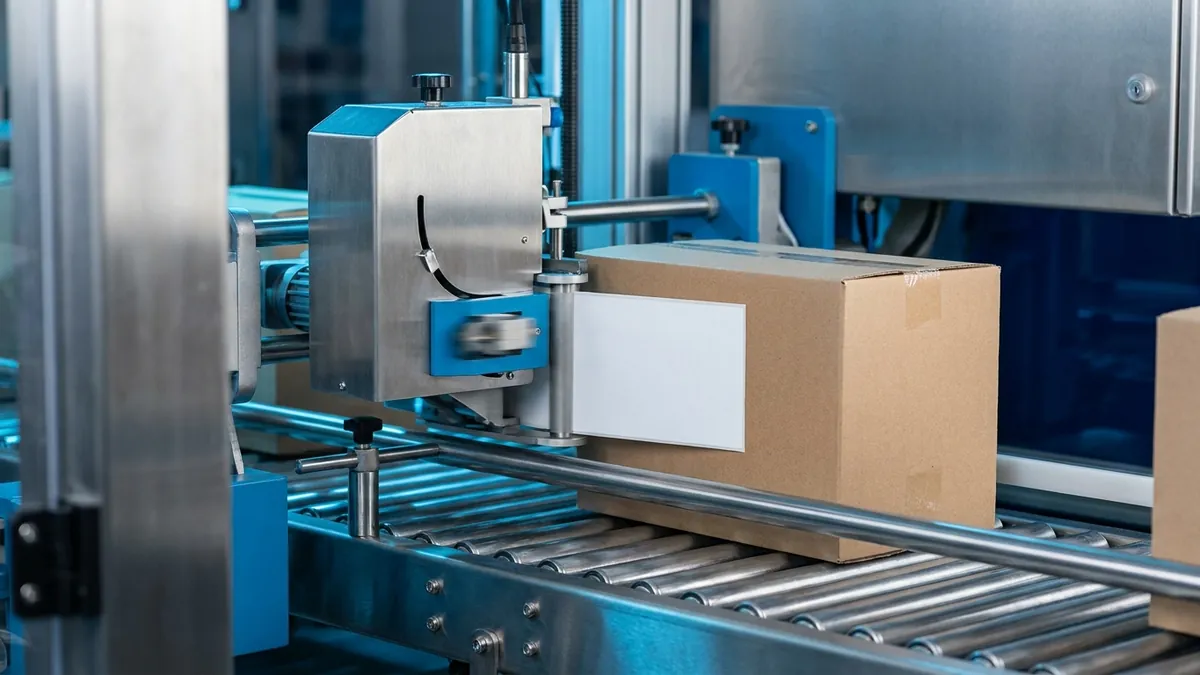
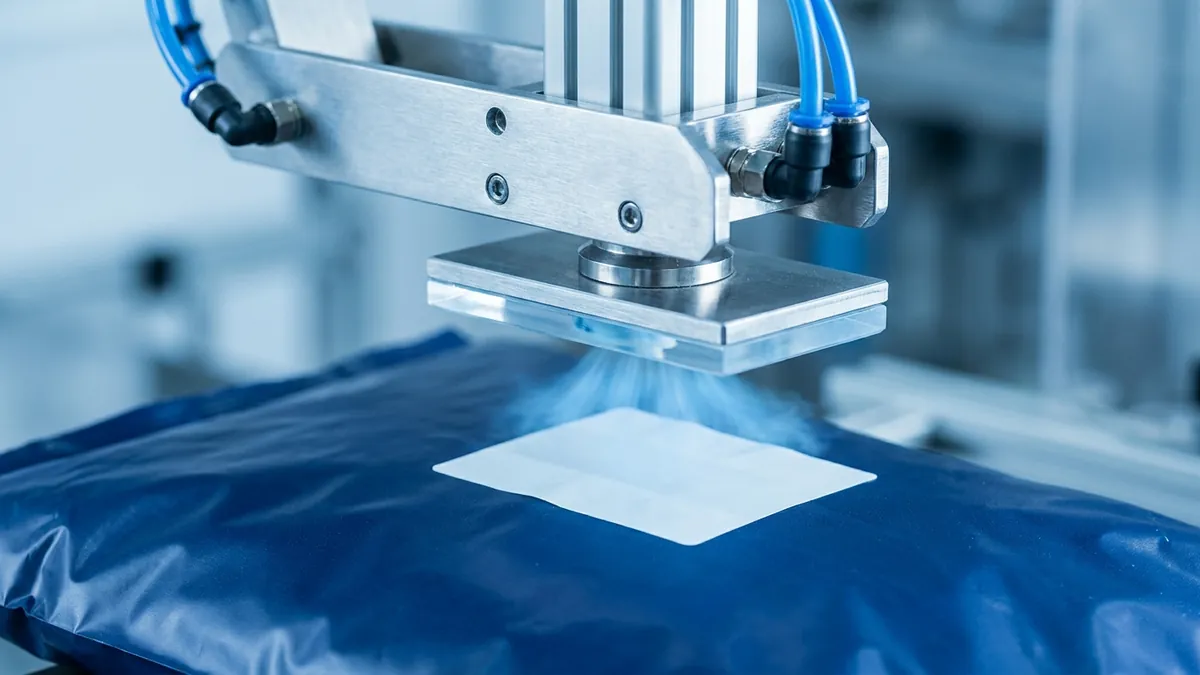
A flat top, or one with mild variation in height, is the natural home of the tamp applicator. A vacuum pad carries the label down on a cylinder stroke and presses it onto the surface, holding placement to roughly plus or minus 0.5 mm. Pressure or photoelectric sensing on the pad lets the stroke self-adapt to product height, so a run of slightly different-height cartons still gets consistent contact without crushing the shortest ones. This is the workhorse case, and a tamp arm at around 35 cycles per minute covers most rigid cartons and cases.
Curved, cylindrical, and moving surfaces
Bottles, jars, cans, and tubes present an arc, and a straight-down tamp stroke touches such a surface at a single line, not a plane. The right motion is a wipe or roll-on arm, which lays the leading edge of the label down and lets the product roll the rest on as it travels past. Because the application happens in motion, wipe arms suit continuous-flow lines and run a little faster, near 50 per minute, with placement around plus or minus 1 mm. Curved surface labeling done with a wipe motion also avoids the bubbles and wrinkles that a flat pad leaves on an arc.
Corners, edges, and multiple faces
Some labels have to bridge an edge. A shipping label that wraps a carton corner so it is readable from two sides needs a corner or right-angle applicator, whose dual-cylinder motion folds a two-panel label around the edge in one stroke. It is slower, near 15 per minute, because the motion is more complex, but no flat arm can do it cleanly. A carton corner labeling machine built on this principle is what keeps the two panels aligned across the fold.
When a product needs labels on more than one face without being re-oriented, a swing arm that moves between front, back, and side positions handles it in a single station, and a double-sided applicator labels two opposing faces at once, which suits pallets and boxes that must be scannable from either side.
- Flat / domed top → tamp arm
- Curved / cylindrical side → wipe or roll-on arm
- Fragile or soft pack → blow (non-contact) arm
- Corner / two-panel → corner / right-angle arm
- Multiple faces → swing or double-sided arm
- Variable placement across a field → three-axis module
Irregular and variable placement
When the label position changes from unit to unit, or the product presents a large working field such as a tray of mixed items, a three-axis module driven by real-time position data places the label anywhere inside its envelope, with travel on the order of 600 by 600 by 320 mm and accuracy near plus or minus 0.7 mm. It is the answer to variable placement, not to speed; a fixed arm still wins when the spot never moves.
Because these arms share a common host, a line that meets several of these surfaces can carry more than one arm and swap as products change. Our labeling systems are organized around exactly this surface-first logic, so the arm follows the product rather than forcing every product to suit one arm.
Order the arm by naming the surface. A five-second description of the product face, its shape, its fragility, and whether the label must bridge an edge, points at the correct applicator far more reliably than a printer spec sheet ever will.