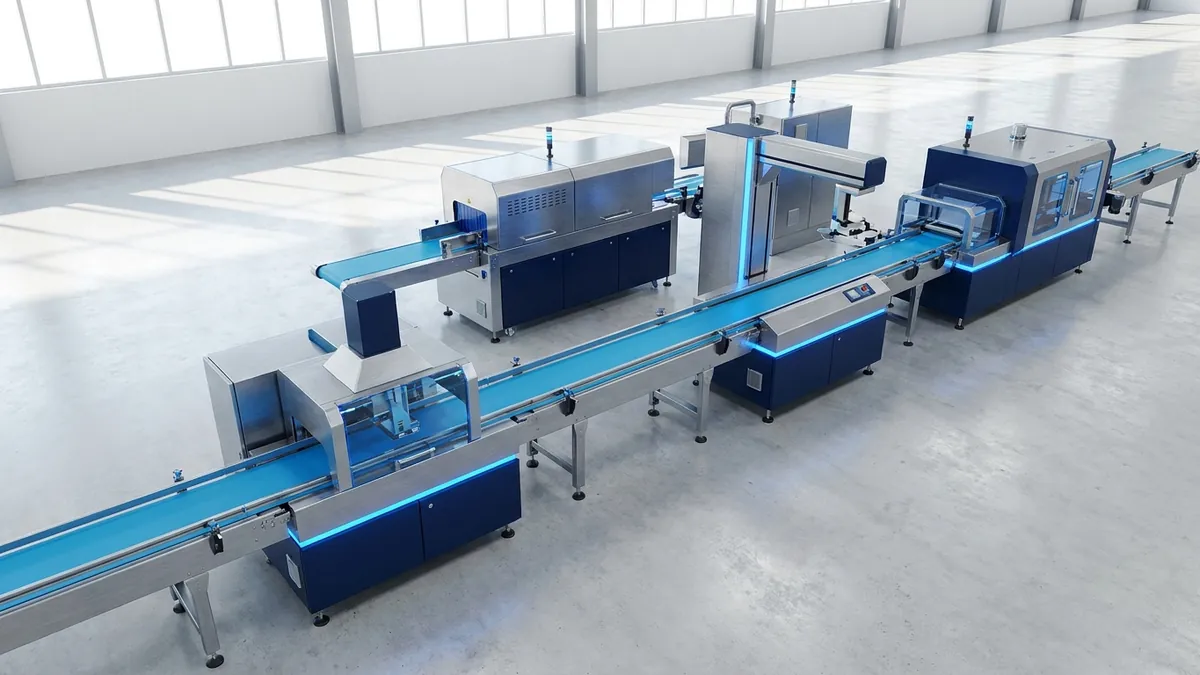
An end-of-line packaging line runs in a fixed sequence: dose or fill, form and seal the primary pack, code it, wrap or shrink where needed, place it in a case, seal the case and strap it. Each stage sets the rate the next one must accept, which is why the order of purchase matters as much as the machines.
The sequence
| Stage | What it does | Sets |
|---|---|---|
| 1. Filling and dosing | Meters product into the pack | Accuracy and fill rate |
| 2. Form, fill and seal | Creates and closes the primary pack | Pack format and line rate |
| 3. Coding and marking | Applies date, lot and variable data | Traceability compliance |
| 4. Shrink or wrap | Bundles or protects the pack | Presentation and transit |
| 5. Case packing | Erects and loads the shipper | Cases per hour |
| 6. Case sealing and strapping | Closes and secures the case | Transit integrity |
The rule that prevents rework: rate flows downstream
Every stage must accept at least the rate of the stage before it. A filler that outruns the bagger creates a queue and a mess; a case sealer slower than the packer stops the line. When you buy in stages, specify each new machine against the rate of the stage that will feed it, not against today's manual rate.
Interfaces that get missed
- Conveyor heights between stages — the most common physical mismatch.
- Electrical supply and phase: three-phase requirements are often discovered on delivery.
- Compressed air capacity for pneumatic stages, sized for the whole line, not per machine.
- Coding position: the code has to be applied where it will be readable after wrapping.
- Space for accumulation between stages so a brief stop does not cascade.
Which stage to buy first
Buy the stage that is currently the manual bottleneck, not the most impressive machine. In most small plants that is case sealing or primary sealing. Automating a stage that is not the constraint moves the queue without raising output.
Across the 137 machine series in our catalogue, every stage of this sequence is available individually, and turnkey line configurations are listed separately for plants commissioning the whole sequence at once.
Browse by production stage in the full catalogue.
Figures in this article are drawn from the 137 machine series SilverSeal currently supplies, not from generic industry averages. Specifications vary by model — check the individual series page before specifying.
Frequently asked questions
Can I buy a line one machine at a time?
Yes, and most plants do. The discipline is to specify each new stage against the rate of the stage feeding it, and to leave physical space for the stages not yet bought.
What is usually the first automated stage?
Primary sealing or case sealing, because both remove high-repetition manual work at modest cost.
How much accumulation should I plan between stages?
Enough to absorb a short stop at the next stage without backing up the previous one. The exact length depends on the rate and the typical stop duration.
Does the coder go before or after shrink wrapping?
Before, if the code must be readable through the film, and the film is clear. After, if the code goes on the outer pack.